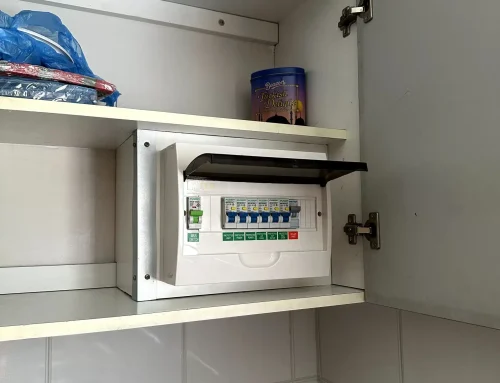
Do I Need a Switchboard Upgrade? 7 Warning Signs to Check Today
Fire and Rescue NSW reports that over 350 residential house fires are started by electrical faults across the state every year (Fire and Rescue NSW, 2026). Your switchboard sits at the center of that risk. It’s the point where every circuit in your home begins, and when it’s outdated, it can’t protect you the way a modern board can.
If you’re asking “do I need a switchboard upgrade,” you’ve probably already noticed something. A fuse that trips too often. A flickering light. An electrician who mentioned it during a service call. This guide walks through the concrete signs that mean it’s time, and the signs that mean you can wait.
Key Takeaways
- Electrical faults cause over 350 house fires in NSW each year (Fire and Rescue NSW, 2026)
- Rewireable fuses in older switchboards don’t protect against electric shock the way modern safety switches do
- Frequent trips, no safety switches, and visible heat damage are the three clearest signals
- AS/NZS 3000:2018 is the current Australian wiring standard electricians upgrade against
- A licensed electrician can confirm in a single visit, usually within 30 to 60 minutes
What Does a Switchboard Actually Do?
A switchboard is the point where mains electricity enters your home and splits into individual circuits for lights, power points, and hardwired appliances (Electrical Safety Office QLD, 2026). It’s also home to your safety switches, the devices that cut power fast enough to prevent a fatal shock.
[PERSONAL EXPERIENCE] Most homeowners never open their switchboard until something goes wrong. That’s normal. But it means problems can sit hidden for years, especially in homes built before the 1990s where the original board was never designed for how much power a modern household actually draws.Think of your switchboard like the fuse box equivalent of your home’s electrical spine. Every appliance, every power point, every hardwired light depends on it working correctly. When it can’t keep up, the symptoms show up everywhere else first, long before the board itself visibly fails.
Citation capsule: A switchboard splits incoming mains power into circuits and houses safety switches designed to cut power before a shock becomes fatal (Electrical Safety Office QLD, 2026).
How Do I Know If My Switchboard Is Outdated?
The clearest sign is what’s inside it. If your switchboard still uses ceramic rewireable fuses instead of circuit breakers and safety switches, it predates the safety standards most Australian homes now rely on. Older-style switchboards often still have rewireable fuses that don’t protect you from electric shock (Electrical Safety Office QLD, 2026).
Homes built before the early 1990s were wired to a much lower power standard. Back then, a household might run a fridge, a few lights, and a television. Now it’s running air conditioners, induction cooktops, EV chargers, and a dozen smart devices at once. The board simply wasn’t built for that load.
You can usually tell the age of a switchboard just by looking at it. Ceramic fuse holders, exposed wiring, or a board that looks like it hasn’t been touched since the house was built are all signs worth a second look.
Citation capsule: Switchboards with rewireable ceramic fuses instead of circuit breakers and safety switches predate current shock-protection standards and are a primary upgrade indicator (Electrical Safety Office QLD, 2026).
Does My Switchboard Have Safety Switches?
Open the switchboard and look for small switches labeled “test” alongside the circuit breakers. If you don’t see any, or you’re not sure, that’s worth flagging to an electrician straight away. Safety switches are designed to cut power within milliseconds if they detect current leaking to earth, which is what prevents electrocution.
Not having a safety switch installed is one of the three most common electrical risks identified on Australian properties, alongside unsafe equipment and contact with powerlines (Electrical Safety Office QLD, 2026).
What Are the Warning Signs I Need a Switchboard Upgrade?
Seven signs consistently show up before a switchboard fails outright, and most of them are things you’d notice during normal daily use rather than needing a technical inspection. Catching them early is what turns a planned upgrade into a routine job instead of an emergency call-out.
1. Circuit Breakers Trip Frequently
If a breaker trips every time you run the kettle and the toaster together, your board is likely undersized for your current load. Occasional trips are normal. Trips several times a week are not.
2. Burning Smell or Scorch Marks
Any burning smell near the switchboard, or visible scorch marks on the panel itself, means heat has built up somewhere it shouldn’t. This is one of the more urgent signs and shouldn’t wait for a scheduled inspection.
3. Flickering or Dimming Lights
Lights that dim when you turn on a large appliance point to a board struggling to distribute load evenly. It’s not always dangerous on its own, but it’s a reliable early indicator.
4. No Safety Switches Installed
Covered above, and worth repeating: if your board has no safety switches at all, this is the single clearest reason to book an upgrade regardless of anything else on this list.
5. The Board Still Uses Rewireable Fuses
Ceramic fuses that you physically rewire after they blow are a strong sign the board predates modern safety standards entirely.
6. You’re Adding Major Appliances
Installing an EV charger, a ducted air conditioner, or a home battery system often requires more capacity than an older board can safely provide.
7. It’s Been More Than 25 Years Since Installation
Even a board that seems fine can be due for review. Visual examination of switchboards and other electrical equipment is recommended once every 12 months as routine good practice (Electrical Safety Office QLD, 2026).
[UNIQUE INSIGHT] Homeowners tend to treat switchboard upgrades as reactive, something you do after a trip or a scare. But the boards we see fail suddenly are almost always the ones showing two or more of these signs for months beforehand. The upgrade decision usually isn’t really about the board. It’s about how many of these signs you’re willing to keep living with.
Is an Old Switchboard Actually Dangerous?
Yes, in the sense that it removes a layer of protection modern boards are built to provide. Electrical distribution and appliance faults caused 24% of household fires and 10% of fire fatalities in a Fire and Rescue NSW analysis of residential fire data (Fire and Rescue NSW, 2026). That’s a meaningful share of a preventable category.
The danger isn’t usually dramatic. It’s cumulative. A board without safety switches doesn’t cause a fire by itself, but it removes the mechanism that would normally stop a small fault from becoming a bigger one. Combine that with an aging board carrying more load than it was designed for, and the risk compounds over years, not overnight.
Citation capsule: Electrical distribution and appliance faults were responsible for 24% of household fires and 10% of related fatalities in NSW fire data analysis, making switchboard condition a measurable safety factor rather than a cosmetic concern (Fire and Rescue NSW, 2026).
What Standard Do Switchboard Upgrades Need to Meet?
AS/NZS 3000:2018, known as the Wiring Rules, is the technical standard Australian electricians follow when designing, constructing, and verifying electrical installations, including switchboard upgrades (Standards Australia, 2026). It sets the baseline for what “compliant” actually means.
This matters practically in two ways. First, insurers can ask about compliance if you ever make a claim involving electrical damage. Second, a non-compliant board can complicate selling a property, since buyers’ inspectors will flag it. Neither of those is the main reason to upgrade, but they’re worth knowing.
A licensed electrician checks your board against these rules during an inspection, not against a generic checklist. That’s part of why a quick phone assessment can’t replace an on-site look.
How Much Does a Switchboard Upgrade Cost?
Cost depends heavily on your board’s current condition, whether asbestos removal is needed, and how many circuits you’re adding. Rather than quote a single figure that may not reflect your situation, the most reliable approach is a fixed-price, on-site quote after a licensed electrician has actually seen the board.
[PERSONAL EXPERIENCE] The upgrades that end up costing more than expected are almost always the ones where hidden issues surface once the old board is opened up, things like deteriorated wiring behind the panel or asbestos sheeting that wasn’t visible beforehand. A proper inspection catches this before work starts, not during it.FAQ: Switchboard Upgrades
How long does a switchboard upgrade take? Most residential upgrades are completed in a single day, though power will be off for part of that time. Your electrician will confirm timing during the quote.
Can I upgrade just part of my switchboard? Sometimes. If only the safety switches are missing, a partial upgrade may be possible. A full board replacement is usually recommended if rewireable fuses are still present.
Will my power be off during the upgrade? Yes, for safety reasons power is disconnected while work is carried out, typically for a few hours depending on complexity.
Do I need council approval for a switchboard upgrade? No council approval is generally required for like-for-like switchboard work, but your electrician will confirm what applies to your specific property.
What happens if I don’t upgrade an old switchboard? The board will keep functioning until it doesn’t. The risk is that faults it can no longer safely absorb, like a circuit overload or an earth leak, go undetected until they cause damage or a shock hazard.
The Bottom Line
If you’re seeing two or more of the warning signs above, particularly frequent trips, no safety switches, or visible heat damage, it’s worth getting a licensed electrician to look at your board. Given that electrical faults cause over 350 house fires annually in NSW alone, a straightforward inspection is a small step for a meaningful reduction in risk (Fire and Rescue NSW, 2026).
A switchboard inspection is quick, usually 30 to 60 minutes, and gives you a clear answer instead of a guess. If an upgrade is needed, you’ll get a fixed-price quote before any work begins.
This article was prepared by the team at Zapptech Electrical, licensed electricians serving the Hawkesbury region.